Call our team for a personal consultation regarding your businesses fire and security needs on 01733 246 990





Nationwide Coverage


 Fire Alarm Design Company
Commercial Fire Alarm Design
Many fire alarm problems start on the drawing: the wrong category, detectors that ignore the conditions they’re in, a design that can’t grow with the building. Britannia designs commercial fire alarm systems to BS 5839-1 around how your building is actually used, because good design avoids costly problems at installation and commissioning.










Fire alarm design for responsible persons and contractors
Fire alarm design lands on two desks: the responsible person who answers for it, and the contractor who has to build it. We design for both.
- Designed for the risk, not a template. Category and device positions follow your fire risk assessment, how the building is used and who’s in it. Detectors are specified for the conditions in each area, because detection that ignores the environment causes nuisance alarms.
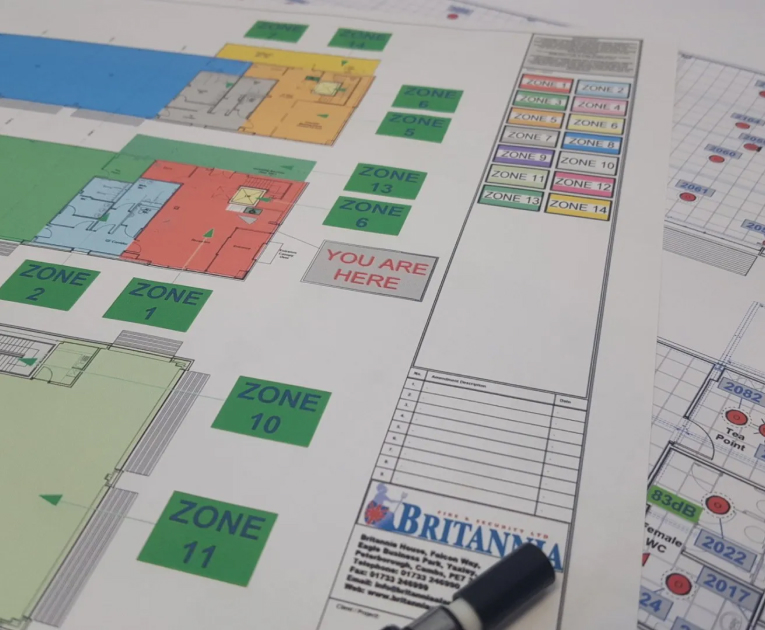
- Drawings you can build from. All our CAD work is done in house, and designs are documented to the standard building control needs for sign-off. Send us existing drawings and we’ll turn them into a CAD design.
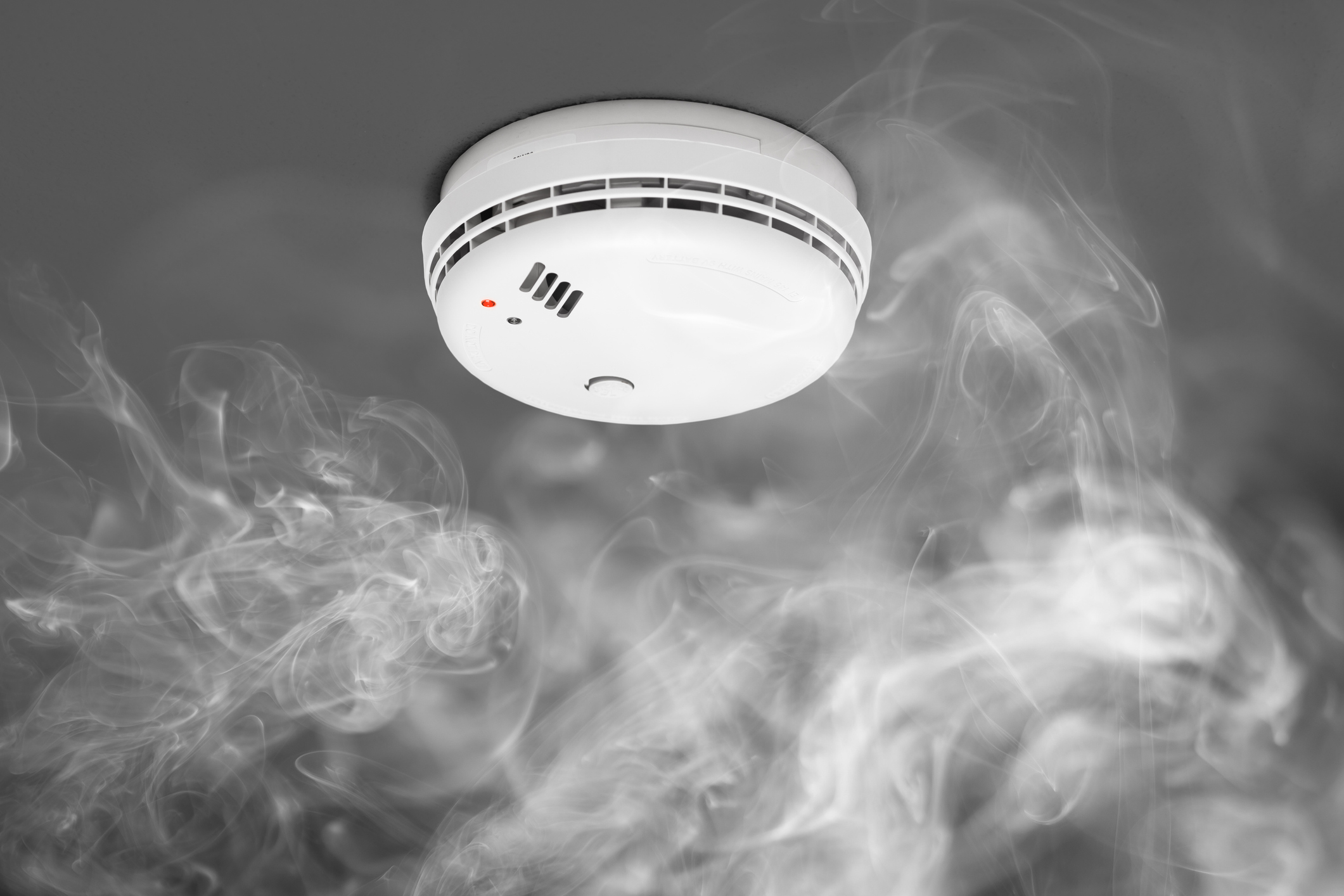
- Integration planned up front. On our projects, fire alarms have been linked to lift and gas shutdown, high-speed shutters, BMS, PA, access control and sprinkler monitoring.
- Room to grow. Designs can allow for future expansion, so devices or zones can be added as the building changes.
- Quick turnaround. Straightforward premises typically within a few days of a site survey; larger or more complex buildings may take one to two weeks.
Designing to BS 5839-1:2025
BS 5839-1:2025 replaced the 2017 edition on 30 April 2025, and it changes how systems are designed:
- every variation should be justified and recorded in the log book. Two are now unacceptable: no zone plan where a storey has more than one zone, and no ARC link in a residential care home or in supported housing that needs a BS 5839-6 Grade A system
- the system category should be agreed with the user or specified by the designer
- L2 now covers rooms where people sleep, which should have smoke, multi-sensor or CO detection, with heat detection only where the fire risk assessment justifies it
- smoke detection now explicitly covers main access and egress stairways, and stairway lobbies
- manual call point siting is simpler, and the competent person definition aligns with BS 4422:2024
- a new Section 7 covers extensions and modifications to existing systems
The legal driver is the Regulatory Reform (Fire Safety) Order 2005 in England and Wales (the Fire (Scotland) Act 2005 in Scotland), which requires appropriate fire detection and warning based on a building’s size, use and occupancy. Since October 2023, fire risk assessments and fire safety arrangements in England must be recorded in full, so your design rationale should be documented to match.
Accredited fire alarm designers
- BAFE SP203 registered (300175): third-party certification for fire detection and alarm work
- Gent 24 Elite Technology Centre, and part of the Gent 24 Network of Approved System Integrators
- FIA member
- NICEIC approved contractor
- ISO 9001, 14001 and 45001, CHAS and Constructionline

Case study: ELeather, Peterborough
A purpose-built factory for ELeather, where electrical contractor EBM Electrical called Britannia in to design and install the fire alarm: a large production floor with ceilings up to 19 metres, heavy machinery and a front office.
We specified a bespoke Honeywell Gent system with site-wide aspirating smoke detection, with devices kept accessible for routine testing. In the front office we found more ceiling beams than first estimated. Void detection identified 149 voids, requiring an additional 140 sensors, around 500 devices in total.
The design also covered sounder beacons across production areas, call points next to every fire escape, lift and gas shutdown, and high-speed shutters to contain fire spread. Installation came in within budget and ahead of schedule.

Free design survey and quote
Send us drawings, your fire risk assessment and any insurer or building control requirements. We’ll survey the building and quote for design, or for design through installation, commissioning and maintenance.
Call 01733 246 990 or email info@britanniaalarms.co.uk.

Our fire alarm design process
- Site survey. An on-site survey to understand your building and your requirements.
- Fire risk review. We can carry out a fire risk assessment to identify areas that are non-compliant.
- Category and design. Category matched to your fire risk assessment, detectors specified for each area’s conditions, and the system designed to BS 5839-1.
- Drawings and documentation. In-house CAD layouts, documented to the standard building control needs for sign-off.
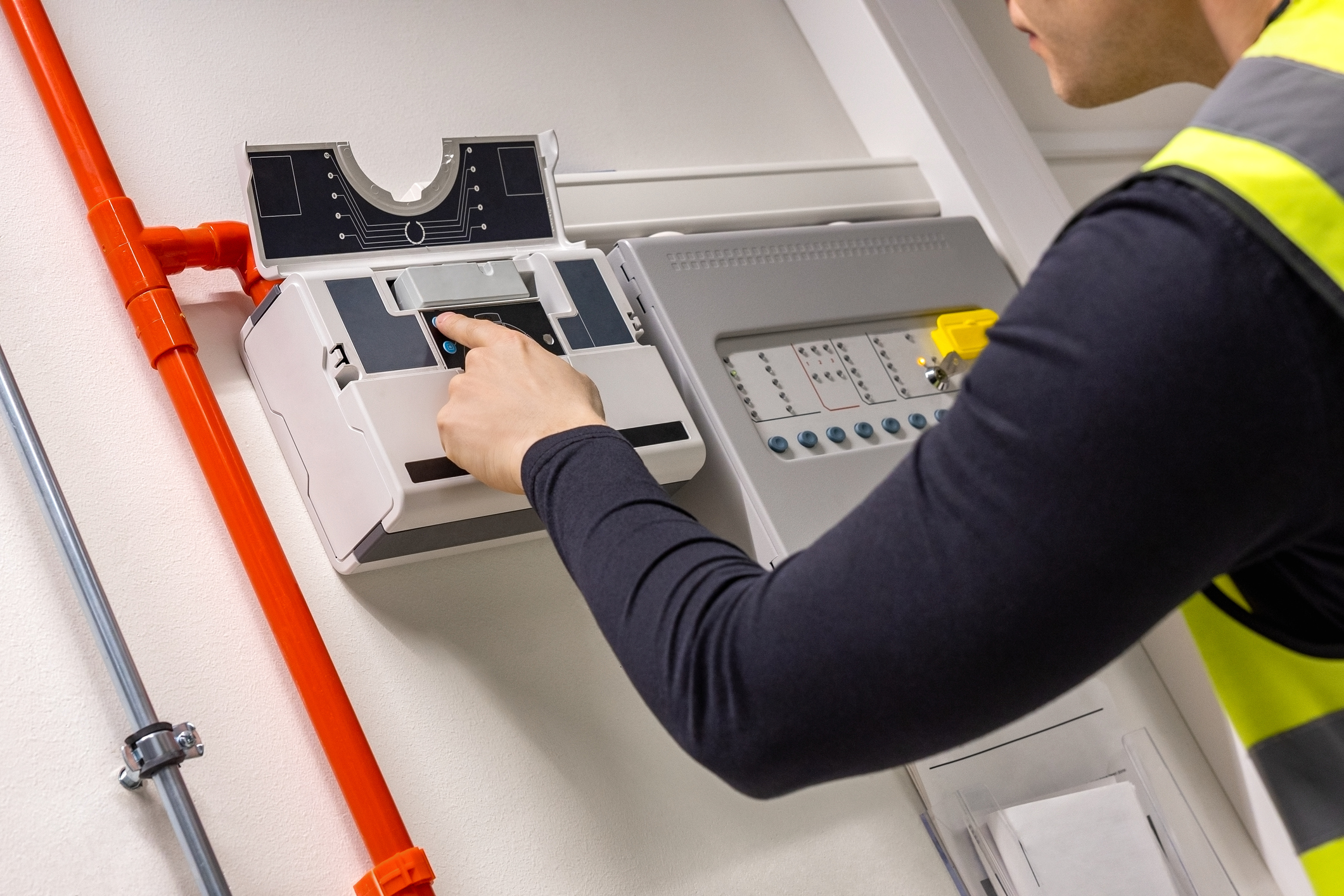
- Next steps. Installation, monitoring and maintenance available from Britannia.

Fire alarm design across the UK
We design fire alarm systems across the UK from our base in Peterborough, with engineers covering Cambridge, Northampton, Leicester, Nottingham, Lincoln and Luton.
Our design work includes a manufacturing plant with 19-metre ceilings, and we’ve installed systems in distribution centres, care homes, leisure centres and a fire station. We also design for offices, schools, retail and local authority buildings.
We work directly for building owners and responsible persons, and as the fire alarm designer for electrical and principal contractors.
Trusted & Fully Qualified
As part of our continued commitment to quality, Britannia Fire and Security has a number of accreditations and quality standards that sets us apart from the competition. We hold ISO 9001, 14001 and 45001 accreditations. We also hold BAFE accreditation.
Here at Britannia Fire and Security, we are very proud of our health and safety affiliations, each one means that we comply with the very stringent quality control measures to service your business. Britannia Fire and Security are also part of the Gent 24 Network of Approved System Integrators operating across Cambridgeshire, East Anglia and the UK. View our full list of accreditations.
Qualifications & Accreditations
ISO 9001
BAFE SP203
ISO 14001
NICEIC Electrical Contractor
ISO 45001 (SSIP)
Constructionline
Gent 24 Technology Centre
CHAS Accredited Contractor
Member Of The FIA
SSAIB Certified







"Britannia Fire & Security are a very approachable and knowledgeable company, proactive in giving quotations within timescales given, very professional on site and backed up with great office support."

"We really enjoy working with Britannia, we find them to be extremely helpful throughout the process from tendering, design, installation and right through to completion. They have been extremely supportive and most importantly in a professional and timely manner."
"Britannia have a vast and incredibly competent knowledge base, that has helped with many challenging issues with complex systems. Planned installation work has always been completed to a high standard and high level of professionalism, with the added reassurance of supportive after sales care."

"Having utilised Britannia for many years as part of our MEP supply chain, would highly recommend their services. Professional and knowledgeable team members complimented by an experienced and skilful engineering team they have assisted us in delivering some high quality projects."

"Concept-MEP carry out a large number of projects in conjunction with Britannia Fire & Security both in the UK & overseas. This has been a long-standing relationship due to the high quality of service and workmanship that they provide"

"More than happy to assist"

"I have used Britannia Fire & Security over the past 15 years at various company’s I have worked for. They offer a very professional service in all aspects of Fire and Security, and everyone in the business is aways willing to assist. I wouldn’t have an issue in recommending Britannia."




The Britannia Promise

Unrivalled Customer Service
Our service and maintenance capabilities and technical back up are second to none, ensuring that our customers have peace of mind using the best quality security system on the market.

Complete Security Solutions
From complex integrated intruder alarm packages to simple fire alarm detection systems, we can tailor any solution to suit your requirements. We provide the best class systems for your business.
Experienced Engineers
With more than 30 experienced engineers at Britannia Fire & Security we are able to provide nationwide coverage for clients in all areas of fire alarms, CCTV and security systems.
Frequently Asked Questions
What’s the difference between a conventional and addressable fire alarm system? >
A conventional system divides a building into zones. When an alarm is triggered, the control panel shows which zone the fire may be in. An addressable system monitors each detector and call point individually. The control panel identifies the exact device that triggered the alarm, helping locate the fire more quickly.
How is a fire alarm system designed for my building? >
Engineers assess the building layout, occupancy type, fire risks, and evacuation strategy. This information is used to design a system that meets safety requirements and complies with BS 5839.
What category of fire alarm system do I need? >
The required category depends on the building’s fire risk assessment and the level of protection needed for occupants and property.
How often does a fire alarm system need to be serviced? >
Most commercial fire alarm systems should be inspected and serviced at least twice per year in line with guidance from BS 5839.
Who is responsible for fire alarm compliance in a commercial building? >
Under the Regulatory Reform (Fire Safety) Order 2005, the responsible person for the premises must ensure the fire alarm system is installed, maintained, and working correctly.
Can a fire alarm system be expanded in the future? >
Yes. Many modern fire alarm systems are designed to be scalable, allowing additional detectors, sounders, or zones to be added if a building expands or changes use.
Why does fire alarm design matter for compliance? >
Fire alarm design is where compliance obligations are either met or missed. A poorly designed system may pass initial installation but fail to meet BS 5839 requirements, create coverage gaps, or generate nuisance alarms that lead to the system being ignored or disabled. Under the Regulatory Reform (Fire Safety) Order 2005, responsible persons are legally required to ensure fire detection and warning systems are appropriate for the premises. Getting the design right from the outset is the most effective way to meet that obligation.
What is a BS 5839 category and how is it chosen? >
BS 5839 Part 1 defines fire alarm system categories for non-domestic buildings. Category L systems are designed to protect life, with L1 providing the most comprehensive coverage and L5 covering a specific localised risk. Category M systems are manual call point only. Category P systems protect property. The appropriate category is chosen based on the fire risk assessment for the building, its occupancy, escape routes, and any regulatory or insurer requirements. The design should reflect this assessment rather than defaulting to a standard specification.
Do I need a fire risk assessment before designing a fire alarm system? >
<p>A fire risk assessment is the foundation of good fire alarm design. It identifies the specific risks in the building, the areas requiring protection, and the level of detection needed. Without it, system design is based on assumptions rather than the actual risk profile of the premises. For most non-domestic buildings, a fire risk assessment is also a legal requirement under the Regulatory Reform (Fire Safety) Order 2005, so the assessment and the design should be considered together from the start of any project.</p>
How long does fire alarm design take? >
Design timescales depend on the size and complexity of the building. For a straightforward commercial premises, a design can typically be completed within a few days of a site survey. For larger or more complex buildings, a detailed CAD design with full documentation may take one to two weeks. The design phase is a small part of the overall project timeline, and investing time in getting it right at this stage avoids significantly longer delays caused by problems during installation or at commissioning.
Can a fire alarm system be designed for future expansion? >
Yes. Where there is a likelihood that a building will be extended or repurposed in the future, this can and should be factored into the design. Addressable systems in particular lend themselves to expansion, as additional devices can be added to the loop without replacing the panel. Good design at the outset means choosing a panel and architecture that can accommodate future growth, avoiding the cost of redesigning and partially reinstalling the system when the building changes.
Who is the responsible person for fire alarm design and compliance? >
Under the Regulatory Reform (Fire Safety) Order 2005, the responsible person is typically the employer, building owner, or the person in control of the premises. This person has a legal duty to ensure the fire alarm system is appropriate for the building, properly installed, and maintained. In practice, responsibility for design and installation is delegated to a competent contractor, but the legal obligation to ensure compliance rests with the responsible person. Choosing a contractor with the right accreditations and demonstrable experience is how that obligation is discharged in practice.
Industry News & Insight
Festive Period Arrangements 2025
Our office will close at Midday on Wednesday 24th December 2025 and will reopen at 9am on Monday 5th January 2026. During the festive shutdown peri...
Planet Mark Business Certification Tier 2
🌍We're pleased to announce that we've now been recording our data for two years.
Festive Period Arrangements 2024
Our office will close at 12:00 on Tuesday the 24th of December 2024 and will reopen at 09:00 on Thursday the 2nd of January 2025. During the festive s...